
Why Spare Parts Visuals Are Essential for Webshops
Part 2 of 5 of our most important insights for spare parts Web shops
In spare parts webshops, customers are often required to select products based on technical names, part numbers, or short descriptions. Unfortunately, these identifiers are frequently unclear, duplicated, or difficult to interpret—especially for non-technical buyers. The result is a high risk of incorrect orders, increased return rates, and lost conversions.
This is where spare parts visuals become critical. By using images such as exploded views, technical drawings, and 3D visualizations, webshops can guide customers toward the correct spare part the first time. Visuals not only improve usability and customer confidence, but they also have a direct impact on conversion rate optimization (CRO), search engine optimization (SEO), and overall ecommerce performance.
In this article, we explain what spare parts visuals are, which types perform best in webshops, how they improve SEO, and how they can be implemented effectively—especially in eCommerce platforms.
What Are Spare Parts Visuals?
Spare parts visuals are images that help customers visually identify the exact part they need. These visuals provide context that text alone cannot deliver. Common examples include product photos, technical drawings, exploded views, and interactive 3D models.
For complex products such as machines, appliances, or industrial equipment, spare parts visuals reduce ambiguity and significantly improve the customer experience. Instead of guessing based on part numbers, users can visually confirm their selection before purchasing.
1. No Image – A Missed Opportunity
Webshops without images force customers to rely entirely on text. This leads to uncertainty, hesitation, and abandonment. From both a UX and SEO perspective, missing images are a major disadvantage.
2. Snapshot or Reference Images
Simple snapshot images offer a basic visual reference. While better than no image at all, they often lack context and do not show how a part fits within the overall product.
3. Standard Product Photos
Standard product photography works well for simple, standalone parts. However, for complex assemblies, these images rarely provide enough information for accurate identification.
4. Technical drawings
Technical drawings add precision and clarity. They are especially valuable for professional users and mechanical components, but may be difficult to interpret for non-technical customers.
5. Exploded Views (Highly Effective)
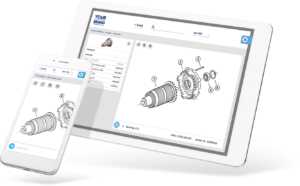
Exploded views show how individual parts fit within a larger assembly. They provide immediate context and dramatically reduce selection errors. This makes exploded views one of the most effective visual formats for spare parts webshops.
6. 3D Renderings and Interactive Models
3D visuals combine accuracy with usability. Customers can rotate, zoom, and explore parts interactively, resulting in higher engagement, better understanding, and increased conversion rates. This is the most advanced—but also the most powerful—visual option.
Conclusion:
We know from our clients that producing visuals and importing them into a Webshop is time-consuming and costly. When you’re finally done, how to keep the visuals up-to-date? But perhaps more important: how does your choice of visuals affect your Webshop conversion?
We don’t have all the answers, but we know which images are already available in most of our clients’ situations: technical drawings and exploded views from parts catalogues.
For us, the exploded views, in particular, are a valuable and cost-effective basis for every spare part Webshop, sometimes in combination with photos.
The Impact of Visuals on Conversion and Returns
Visual clarity directly influences buying confidence. When customers can clearly see which part they are ordering:
- Conversion rates increase
- Customer support requests decrease
- Return rates drop significantly
- Overall customer satisfaction improves
For spare parts ecommerce, visuals are not a “nice to have” feature—they are a critical business tool.
Implementing Spare Parts Visuals in eCommerce platforms
eCommerce platforms offer flexibility, but standard product pages are often insufficient for complex spare parts catalogs. Advanced visuals can be implemented through:
- Custom product page integrations
- External visual parts selectors
- API-based platforms that connect visual data to eCommerce
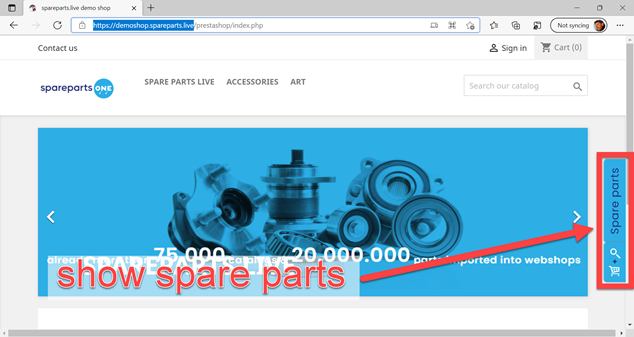
Solutions like spareparts.live allow webshop owners and developers to integrate exploded views and visual selectors directly into the eCommerce platform, without disrupting existing themes or workflows.
Best Practices for Spare Parts Visuals
- Always combine visuals with clear labels or part numbers
- Use consistent naming conventions for images
- Optimize image size for performance
- Include visuals directly within the product selection flow
- Ensure visuals are accessible and mobile-friendly